ServicesUV Water Treatment
UV Water Treatment in Allen, Sized and Set Up Right
A UV system shines 254-nanometer light through your water to stop bacteria, viruses and cysts from reproducing. It adds no chemicals and changes nothing about taste. We size the chamber to your home's flow, put the right prefilter ahead of it, and the same small crew handles it start to finish.
What UV Does, and What It Doesn't
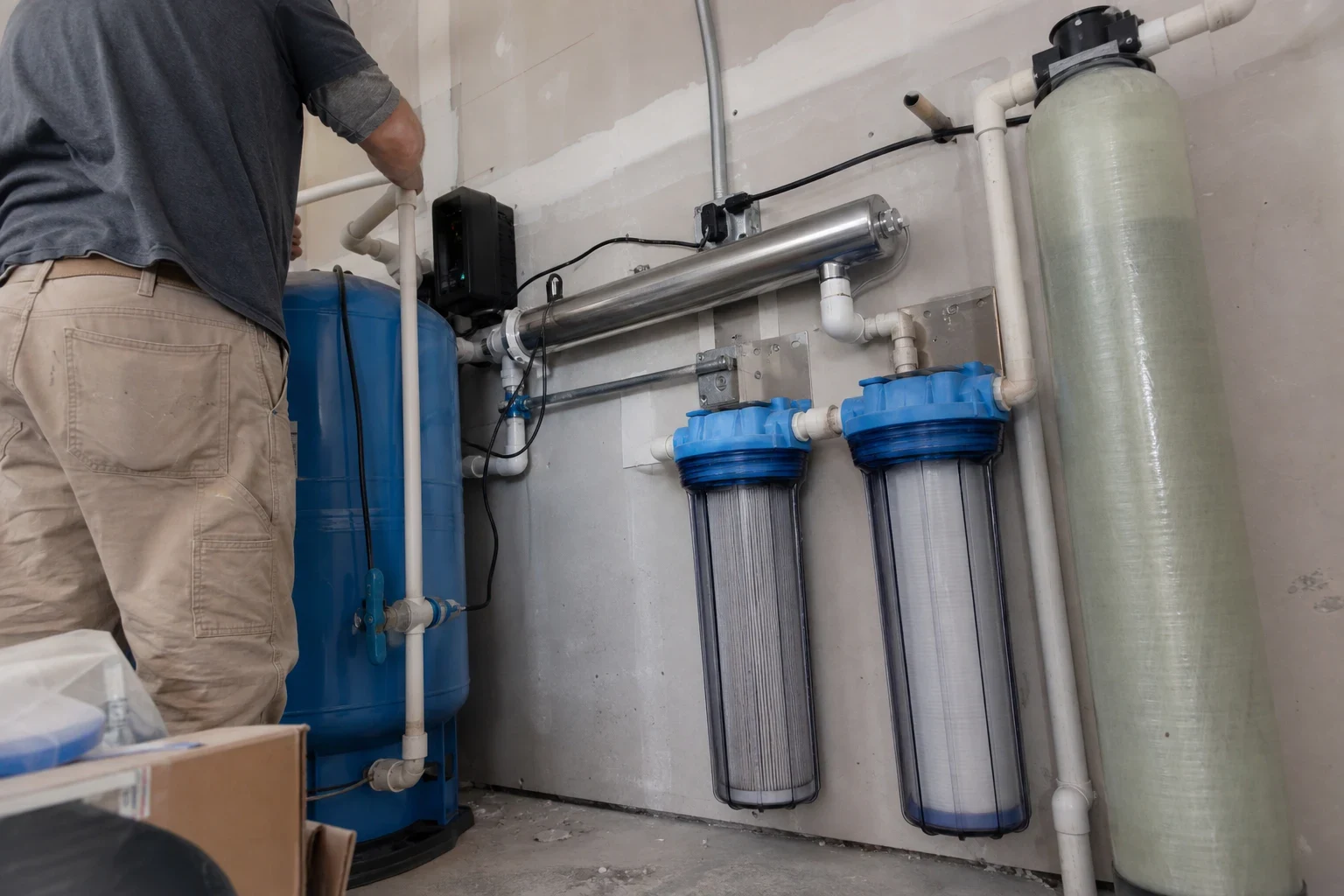
Inside a UV unit, water flows through a stainless steel chamber around a quartz sleeve. A low-pressure mercury lamp inside that sleeve gives off ultraviolet light, which damages the DNA of microorganisms so they cannot multiply or make you sick. The water spends only a second or two in the chamber, so the system has to deliver enough dose (measured in millijoules per square centimeter) at your peak flow, not your average flow.
UV is a disinfection layer, not a filter. It does not remove chlorine, lead, hardness, sediment or anything that affects taste. It also leaves no residual, so it protects water at the moment it passes through the chamber. For most homes on treated city water, UV makes sense as a backup safeguard, usually alongside whole-home filtration or reverse osmosis rather than in place of them.
We start with a water test and a water report, so you can see what is in your water before deciding whether UV belongs in the plan.
What Our UV Installation Includes
Flow-based sizing
We check your home's peak demand in gallons per minute, counting bathrooms, fixtures and irrigation tie-ins. An undersized chamber lets water pass too fast for a full dose.
Sediment prefilter
Particles can shade microorganisms from the light. We install a sediment cartridge, typically around 5 microns, ahead of the chamber so the light reaches every part of the stream.
Correct placement on the line
UV goes last in the treatment train, after any softener or carbon filter, so it sees the cleanest water. We also plumb in a three-valve bypass loop, which lets a lamp or sleeve change happen while your faucets keep running.
Ballast and alarm setup
The ballast powers the lamp and runs the alarm that tells you when the lamp fails or reaches the end of its rated life. We mount it where you can hear it and need a nearby outlet for it.
Plumbing sanitization
UV cannot clean pipes that are already downstream of it. After installation we sanitize the lines past the unit so you start clean.
Signs a UV System Is Worth a Look
Boil-water notices worry you
City water is disinfected at the plant, but line breaks and pressure drops can trigger notices. A UV unit gives you a second barrier at your home's point of entry.
Someone at home has a weakened immune system
Infants, older relatives and people in medical treatment are more sensitive to microbes. Many families add UV as extra protection for them.
Your existing unit is alarming
A beeping ballast usually means a dead lamp or a lamp past its hours. Lamps can still glow while their UV output has dropped too low to disinfect.
The quartz sleeve looks cloudy
Mineral scale and iron film block the light. If the sleeve fouls quickly, the water ahead of it needs better pretreatment, sometimes a softener.
You bought a home with a UV system
If you don't know when the lamp was last replaced or how the unit was sized, it is worth having us check it before you rely on it.
How a UV Install Day Runs
- 1
Water test and walkthrough
We test your water and look at where your main line enters, whether in the garage, a utility closet or outside. Hardness and iron readings tell us whether the sleeve will stay clear.
- 2
Written plan by phone
We explain the chamber size, the prefilter and any pretreatment we recommend, and why. You get a clear quote before anything is scheduled.
- 3
Installation
The same people you met do the work. We shut off water, cut in the bypass and prefilter, mount the chamber and ballast, and pressure-test every joint.
- 4
Sanitize, start up and show you
We sanitize downstream plumbing, flush the lines and confirm the lamp and alarm work. Then we show you how to change the lamp, clean the sleeve and swap the prefilter, and we clean up before we leave.
What Moves the Cost of UV Treatment
A UV system's price depends mostly on how much water it has to treat and what has to happen before the water reaches it. We go through each part of the quote by phone so you know what you are paying for. Standard professional installation is included for qualifying homes.
- Chamber size and flow rating
- Larger homes with more bathrooms need a chamber rated for higher gallons per minute, which means a longer lamp and bigger housing.
- Pretreatment needs
- If your water test shows hardness or iron high enough to foul the sleeve, a softener or added filtration may belong ahead of the UV unit.
- Location of the main line
- An accessible garage line is simpler than a tight closet or an exterior connection that needs protection from weather and sun.
- Electrical access
- The ballast needs a standard outlet close by. If there isn't one, an electrician may need to add it.
- Monitoring options
- Basic units have a lamp alarm. Some add a UV intensity sensor that measures actual light output through the water, which costs more.
Common Questions About UV Treatment
Something not covered here? (972) 945-9687
Will UV improve how my water tastes?
No. UV acts only on microorganisms and leaves chlorine, minerals and odors as they are. For taste, a whole-home carbon system or a reverse osmosis unit at the kitchen sink does the job, and both can work alongside UV.
When should the lamp be replaced?
Most home lamps are built for roughly a year of nonstop use. Many keep glowing past that point while their UV output drops, which is why the ballast alarm tracks the hours. Change the lamp on schedule even when it seems fine.
Is UV needed on city water?
Not necessarily. City water has already been disinfected, so UV is an extra layer rather than a must. It's most worthwhile when someone at home is medically vulnerable or when you want coverage during main breaks and boil-water notices.
What happens to UV during a power outage?
It stops working. The lamp runs on electricity, and water moving through a dark chamber is not treated. The ballast turns the lamp back on when power returns, but running your taps for a short time after an outage is a good idea.
Does the lamp stay on around the clock?
Yes. It takes time to warm up to full strength, and switching it on and off often wears it out sooner, so it runs continuously. It uses about as much power as an ordinary light bulb.
Find Out if UV Fits Your Home
Tell us about your home and what you want protection from. We'll set up a water test, then explain whether UV, filtration or both make sense, with the same crew from first visit to final cleanup.